
Simulating collaborative learning is a critical yet challenging goal in educational technology. While recent Large Language Model (LLM) advance-ments show promise, existing approaches often rely on static error models and rigid dialogue control and are primarily designed as student-facing training tools. To address these limitations, we present an autonomous ‘zero-player’ multi-agent simulation platform, powered by GPT-4o, designed as a computational testbed for research. Our key contributions are a data-driven, probabilistic engine for modeling a realistic spectrum of student capabilities, and a fine-grained, consensus-driven dialogue protocol that fosters emergent, bottom-up collaboration. Qualitative evaluations demonstrate that our system generates sound, expert-aligned problem solutions and, critically, produces plausible collaborative dynamics, including peer-to-peer error identification and correction. Our work establishes a high-fidelity platform for studying the mechanisms of collaborative learning and lays the groundwork for future predictive tools to help educators optimize student grouping.
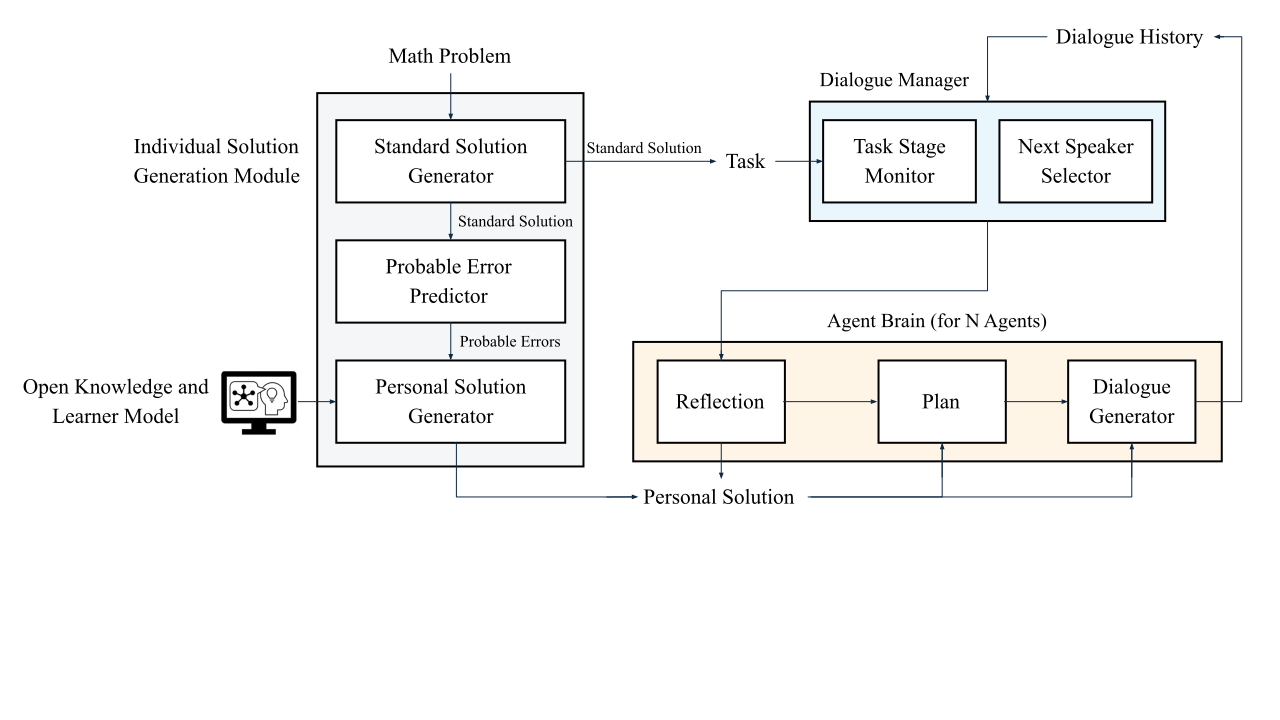
The platform enables a shift from intuitive classroom management to proactive, evidence-based pedagogy. For instance, an institution could integrate this simulation engine, allowing educators to run "in-silico" experiments using their own student data. This would allow them to forecast the collaborative dynamics of various group compositions before classroom implementation, directly addressing the challenge of designing optimal groupings to maximize peer scaffolding.
| 氏名 | コース | 研究室 | 役職/学年 |
|---|---|---|---|
| Yu Yan | 社会情報学コース | 緒方研究室 | 博士1回生 |
| Changhao Liang | 学術情報メディアセンター | 緒方研究室 | 研究員 |
| Hiroaki Ogata | 学術情報メディアセンター | 緒方研究室 | 教授 |